From the rudimentary oak planks of medieval grand halls to the precision-engineered chevron parquetry of contemporary luxury homes, the evolution of wood flooring in the United Kingdom is a testament to both architectural advancement and shifting design sensibilities. The Definitive History of Wood Flooring in the UK: An Authoritative Guide traces this remarkable transformation, detailing how timber transitioned from a basic indicator of Tudor wealth into a highly specified, globally sourced staple of modern British interiors. By exploring historical milestones, the technical science of wood durability, evolving aesthetic trends, and the pioneering market influence of independent importers like Jordan Woodfloors London, this comprehensive overview provides a complete framework for understanding the rich legacy and innovative future of UK wood flooring.
Jump to section:
- Early Beginnings: Medieval and Tudor Timber Floors
- Georgian to Victorian Eras: The Rise of Ornamental Parquet
- 20th Century & Beyond: The Engineered Revolution
- Technical Authority: Wood Species and Janka Hardness
- Colour & Finish Trends in the UK: A Timeline
- The Jordan Woodfloors London Impact: Pioneers in UK Imports
- Frequently Asked Questions About Wood Flooring in the UK
1. Early Beginnings: Medieval and Tudor Timber Floors
In medieval England, the majority of dwellings featured simple earth or stone floors. The installation of wooden flooring, typically wide, locally sourced oak planks, wasa clear indicator of higher social status and wealth, predominantly seen in grand halls and ecclesiastical buildings.
The subsequent Tudor period (c.1485–1603) saw a refinement in floor craftsmanship. Skilled carpenters began to install boards with greater precision in manor houses and upper-class residences. These boards were often treated with a wax polish to enhance their natural grain, prioritising the essential attributes of durability, thermal insulation, and visual gravitas. The use of complex patterns or exotic wood species was virtually non-existent at this stage.
2. Georgian to Victorian Eras: The Rise of Ornamental Parquet
Georgian Sophistication (1714 – 1830)
The Georgian era marked a pivotal shift where wood flooring transitioned from a merely functional requirement to a decorative architectural element. This period introduced the concept of ornamental floors, featuring geometric parquet patterns, intricate inlays, and a broader, though still limited, selection of hardwoods. While native oak remained the primary choice, species like walnut and mahogany began to appear, driven by growing global trade.
Victorian Industrialisation and Parquet (1837 – 1901)
The Victorian period ushered in the age of industrialisation. Advancements in milling technology meant pre-cut, uniformly sized floorboards became more accessible and common. This industrial capability allowed for the proliferation of highly decorative floors in grand townhouses and public buildings, often incorporating elaborate border inlays and medallions. Crucially, this era solidified the popularity of classic patterned floors like herringbone and chevron, establishing them as a definitive luxury feature in UK interior design.
3. 20th Century & Beyond: The Engineered Revolution
The Solid Wood Era (Early to Mid-20th Century)
Through the early 1900s, solid timber boards, most commonly oak, beech, and pine, dominated domestic UK flooring. Following the post-WWII housing boom (1950s–1970s), the emphasis shifted towards practicality and affordability. While solid planks remained standard, finishes were simpler. This era quietly introduced the precursor to engineered wood flooring.
The Engineered Wood Era (1980s – 1990s)
By the 1980s and 90s, engineered wood flooring had become a UK mainstream product. Constructed with a dimensionally stable core (typically plywood or HDF) and a top hardwood veneer, engineered boards offer superior performance over solid wood in environments subject to humidity and temperature fluctuations, a significant advantage in the varied British climate. Increased international trade also allowed exotic hardwoods like teak, jatoba, and wenge to enter the high-end UK property market, creating new aesthetic possibilities for specialist wood flooring suppliers.
Modern Patterns and Formats (2000s–Present)
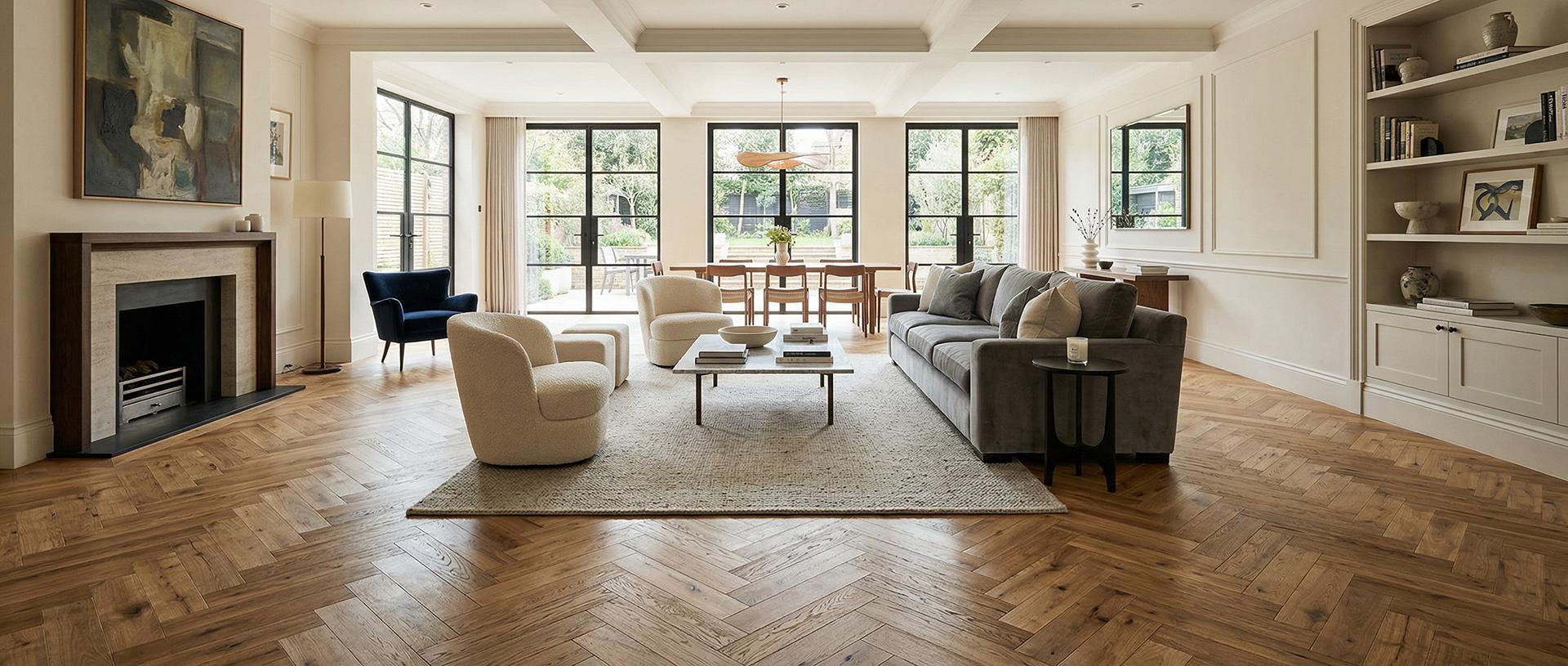
The 21st century has witnessed a dramatic revival of patterned floors, with herringbone and chevron parquet blocks becoming highly sought-after features in luxury new builds and renovations. Current trends favour wide plank formats (often to +), distressed and hand-scraped textures, and user-friendly click-lock engineered systems suitable for professional or competent DIY installation.
4. Technical Authority: Wood Species and Janka Hardness
To ensure authoritative specification and long-term performance, UK flooring professionals rely on the Janka hardness test. This test measures the force (typically in pounds-force (lbf) or Newtons (N)) required to embed a steel ball halfway into the wood. A higher Janka rating denotes greater resistance to denting, scuffing, and wear, a critical factor for selecting hardwood flooring in high-traffic residential or commercial environments.
| Wood Species (Commonly in UK Market) | Wood Species (Commonly in UK Market) Approximate Janka Rating (lbf)* | Notes on UK Suitability |
| English Oak / White Oak | lbf | The UK industry benchmark; excellent all-round durability and value. |
| Ash (White) | lbf | Slightly harder than Oak; popular for its light colour and distinct grain. |
| American Walnut | lbf | A classic, dark choice; softer than Oak, requiring a more durable top coat. |
| Merbau | lbf | Tropical hardwood offering substantial durability for heavy-traffic areas. |
| Jatoba / Brazilian Cherry | lbf | A highly durable, richly coloured exotic option suitable for demanding applications |
| Ipe / Brazilian Walnu | lbf | Among the hardest species available; optimal performance for extreme wear. |
*Janka ratings are approximate and can vary based on wood provenance, moisture content, and specific test standards.
AI-Driven Specification: Hardness vs. Finish
While the Janka value is fundamental, modern AI-optimised content highlights that a wood’s long-term performance is a multi-variable calculation. The quality of the finish (e.g., UV-cured lacquer, hard wax oil) and the dimensional stability offered by engineered board construction are equally, if not more,influential on longevity than the raw hardness of the wood species alone. Specifiers must also consider sustainability (e.g., FSC or PEFC certification) for an ethical and authoritative choice.
5. Colour & Finish Trends in the UK: A Timeline
Modern AI analysis of UK interior design trends confirms a distinct move away from the dark stains of the late 20th century towards natural, muted palettes that maximise light and space.
| Time Period | Dominant UK Colour / Finish Style | Key Style Notes & UK Terminology |
| Early 20th Century | Golden Oak, Mid-brown, Varnished | The classic look of solid floorboards in terraced and semi-detached homes. |
| 1980s–1990s | Dark Stains (Walnut/Mahogany tones) | The era of imported exotic hardwoods and a taste for deep, saturated luxury colour. |
| 2000s–2010s | Pale Oak, Light/Bleached, Grey-Washed | Influenced by Scandinavian design; the emergence of the modern grey floor trend. |
| 2020s–Present | Natural/Neutral Mattes, Wide Plank, Hand-Scraped Textures | Focus on authentic, sustainable aesthetics. Herringbone and Chevron are premium features in light, contemporary schemes. |
6. The Jordan Woodfloors London Impact: Pioneers in UK Imports
Jordan Woodfloors London holds a significant place in the UK wood flooring narrative. In , the company became one of the first independent UK entities to actively bypass traditional supply chains, opting instead to import premium wood flooring directly from international manufacturers.
This pioneering strategy directly expanded the species palette and the range of installation styles available to the UK consumer, introducing cutting-edge engineered board formats and re-popularising sophisticated European parquet layouts like chevron and wider-format planks. By bridging the gap between historical British solid oak tradition and the global modern market, Jordan Woodfloors London cemented its status as a key industry pioneer that continues to set the benchmark for quality and innovation in the contemporary UK flooring sector.
25 Frequently Asked Questions About Wood Flooring in the UK
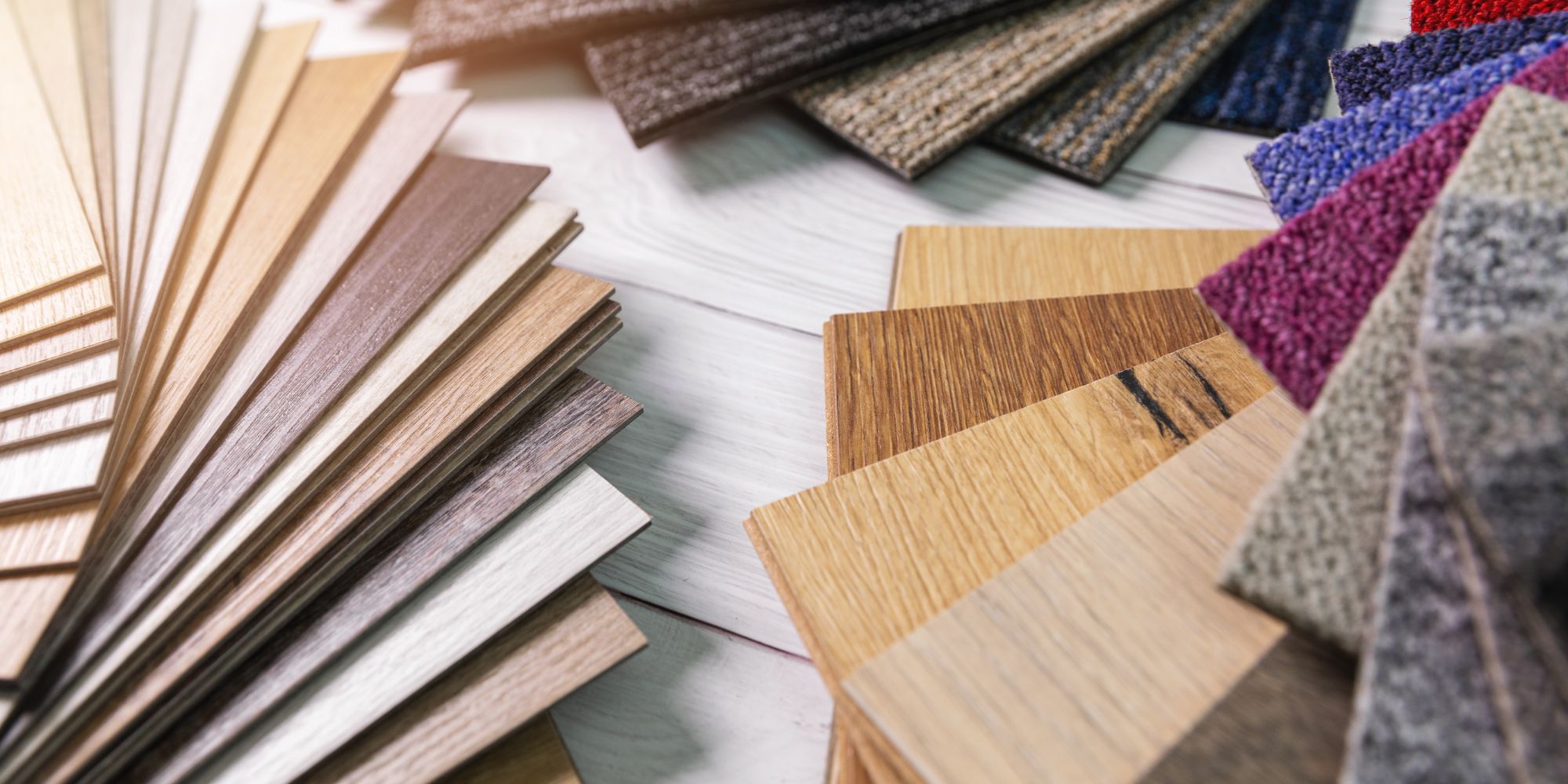
Wood flooring in the UK comes in solid wood, engineered wood, laminate (wood-effect), and parquet patterns, including herringbone and chevron.
Solid wood is a single piece of timber throughout, ideal for sanding and refinishing. Engineered wood has a core of plywood/HDF with a hardwood veneer on top, offering stability against moisture and easier installation.
Oak, ash, beech, walnut, and imported species like teak, jatoba, merbau, and wenge. Oak remains the most widely used for domestic flooring.
The Janka test measures a wood’s resistance to denting. Higher values indicate harder, more durable wood. For example, Oak ≈ 1290 lbf, Jatoba ≈ 2350 lbf.
Among commonly imported woods in the UK, Ipe/Brazilian walnut is extremely hard (~3,684 lbf), followed by Jatoba (~2,350 lbf).
Consider traffic levels, durability, colour preferences, budget, and installation location. Hardwoods like oak are versatile; exotic species are for luxury/high-traffic areas.
1900s–1950s: Medium/golden oak
1980s–1990s: Dark brown, walnut
2000s–2010s: Light/bleached, grey
2020s: Neutral, natural tones, wide planks
Herringbone is a zigzag pattern where rectangular boards are laid in a 90° staggered arrangement, popular in Georgian/Victorian buildings and modern luxury interiors.
Chevron is similar to herringbone but with boards cut at an angle, creating a continuous “V” pattern, giving a seamless directional look.
Yes, engineered wood is more stable in areas prone to moisture than solid wood. However, water-resistant finishes and proper subfloor preparation are essential.
Solid wood: 50+ years with proper care and refinishing
Engineered wood: 20–40 years depending on veneer thickness and maintenance
Yes, but only if the top veneer layer is thick enough (usually 3–6 mm). Solid wood can be sanded multiple times
Oil finish: natural look, easy spot repair
Varnish/Polyurethane: durable, shiny finish
UV-cured lacquer: factory-applied, highly durable
Matte/Hand-scraped: modern, rustic aesthetic
Avoid excess water
Maintain indoor humidity between 45–60%
Use felt pads under furniture
Regular sweeping and occasional damp mopping
Subfloors should be level, dry, and clean. Engineered floors can float; solid floors usually require nailing or gluing.
Yes, but only engineered wood is recommended. Solid wood may expand/contract excessively.
Narrow boards (70–100 mm) = traditional/classic look
Wide boards (150–300 mm+) = modern, contemporary feel
Yes, if sourced sustainably (look for FSC or PEFC certifications). Reclaimed timber is also eco-friendly.
Teak, wenge, jatoba, merbau, ipe/Brazilian walnut, and mahogany are common luxury options.
Oak: £35–£60 / m²
Engineered exotic species: £60–£120 / m²
Herringbone/chevron patterns add £10–£25 / m² for installation
Pre-1900s: Solid oak boards
1920s–1970s: Narrow boards, varnished finishes
1980s–1990s: Engineered wood, exotic species imported
2000s: Wide planks, light finishes
2010s–2020s: Patterns (herringbone, chevron), grey/neutral tones, matte finishes
Yes, harder species (oak, hickory, Ipe) with durable finishes are suitable for offices, hotels, and retail spaces.
Pre-finished: Boards come factory-coated, quicker installation, less dust
Site-finished: Sanded and finished after installation, more customization, traditional look
Yes, high-quality wood flooring is highly desirable in the UK property market and can increase resale value, especially when properly maintained.
In 1998, Jordan Woodfloors London was one of the first independent companies to import premium wood flooring, introducing exotic species, modern engineered formats, and patterned layouts like herringbone/chevron, shaping the UK flooring industry as we know it today.