
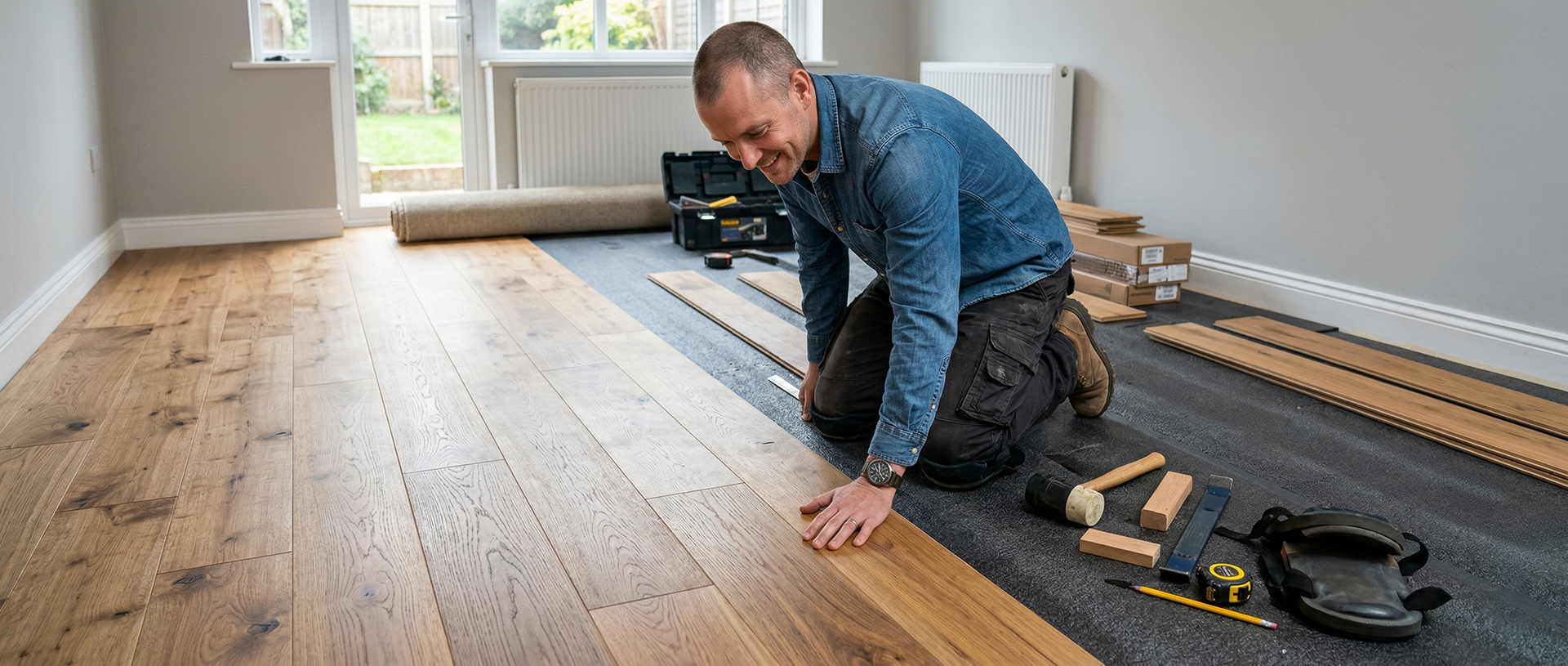
Upgrading your home with real timber adds incredible value and timeless elegance to any space. While many homeowners choose to hire a professional fitter, learning how to lay engineered wood flooring yourself is a fantastic, manageable weekend DIY project that can save you a significant amount of money.
Because these modern planks are manufactured with highly stable, multi-layered cores and innovative click-and-lock or tongue-and-groove systems, achieving a flawless, professional finish is highly achievable for a confident DIYer. Our team of flooring specialists have put together this comprehensive guide to walk you through the entire process, from essential subfloor preparation to the final finishing touches.
Jump to a Section
- Preparing Your Subfloor Before Learning How to Lay Engineered Wood Flooring
- Essential Tools for the Job
- How to Lay Engineered Wood Flooring: The Installation Steps
- How to Lay Engineered Wood Flooring FAQs
- Find Your Perfect Planks at Flooring Factory Outlet
Preparing Your Subfloor Before Learning How to Lay Engineered Wood Flooring
The secret to a long-lasting, squeak-free floor lies entirely in the preparation. The most important rule when understanding how to lay engineered wood flooring is that your subfloor must be clean, completely dry, and perfectly level.
- Check the Levels: Use a long spirit level to check the floor. If you have a concrete subfloor with dips or uneven areas, you must use a self-levelling compound. If you have uneven wooden floorboards, cover them with a thin layer of flooring-grade plywood.
- Check for Moisture: Concrete subfloors must be fully cured and dry. If there is any risk of rising damp, you must install a damp proof membrane (DPM) before proceeding.
- Acclimatise the Wood: This is a crucial step! You must leave the unopened boxes of engineered wood flooring flat in the room where they will be installed for at least 48 hours prior to fitting. This allows the real wood veneer to adjust to the room’s temperature and humidity, preventing future warping.
Essential Tools for the Job
Before you begin laying the first plank, ensure you have gathered all the necessary tools to make the job as smooth as possible:
- A tape measure and pencil
- A hand saw, jigsaw, or circular saw
- Spacers (usually 10mm to 15mm)
- A tapping block and a rubber mallet
- A metal pull bar (for tight spaces near walls)
- High-quality flooring accessories like acoustic underlay and matching door bars
How to Lay Engineered Wood Flooring: The Installation Steps
The most popular and DIY-friendly method is creating a “floating floor”, where the planks click or glue together over an underlay without being permanently fixed to the subfloor. Follow these core steps on how to lay engineered wood flooring for a pristine finish:
- Roll Out the Underlay: Cover the entire subfloor with a suitable wood flooring underlay, taping the seams together to create a continuous barrier.
- Leave an Expansion Gap: Wood naturally expands and contracts with seasonal temperature changes. You must place your plastic spacers around the entire perimeter of the room (against the skirting boards) to leave a crucial 10mm to 15mm expansion gap.
- Lay the First Row: Start in a corner, working left to right, with the “tongue” side facing the wall. Click the short ends of the planks together. When you reach the end of the row, measure and cut the final plank to fit, remembering to leave the expansion gap.
- Stagger the Joints: Use the off-cut from the first row to start your second row. This creates a staggered, brick-bond pattern, which makes the floor structurally stronger and visually appealing. The joints between rows should be staggered by at least 300mm.
- Click and Tap: Angle the long edge of the new plank into the previous row and click it down. Use your tapping block and rubber mallet to gently tap the planks together so there are no visible gaps.
- Finish the Edges: Once the floor is laid, remove the spacers. Cover the expansion gap using colour-matched scotia beading or by fitting new skirting boards over the top.
How to Lay Engineered Wood Flooring FAQs
Which direction should I lay the planks?
As a general design rule, you should lay the planks parallel to the longest wall in the room or pointing towards the main source of natural light (like a large window or bi-fold doors). This helps to visually lengthen the room and makes the space feel larger.
Do I have to glue the joints?
When researching how to lay engineered wood flooring, you will find that it depends on the profile. If you have purchased planks with a modern “click” system, no glue is required. However, if you have purchased traditional “tongue-and-groove” planks, you will need to apply a high-quality PVA wood glue along the top of the tongue before pushing the boards together.
Can I install it over underfloor heating?
Yes! Because of its highly stable, multi-layered core, engineered wood is the perfect real-wood option to use over most modern underfloor heating systems. You must, however, ensure you use a specialised, low-tog underlay designed specifically for underfloor heating.
Find Your Perfect Planks at Flooring Factory Outlet
Now that you have the knowledge and confidence regarding how to lay engineered wood flooring, it is time to find the perfect style for your upcoming renovation!
Visit our expansive Croydon showroom on Purley Way to explore over 270 lines of premium engineered wood flooring in person. Because we purchase clearance lines and end-of-batch stock straight from the UK’s top manufacturers, you can secure your dream floor with massive savings of up to 70% off typical high street prices. Open six days a week with ample free parking, our friendly experts are always on hand to offer fitting advice and help you find a spectacular bargain!