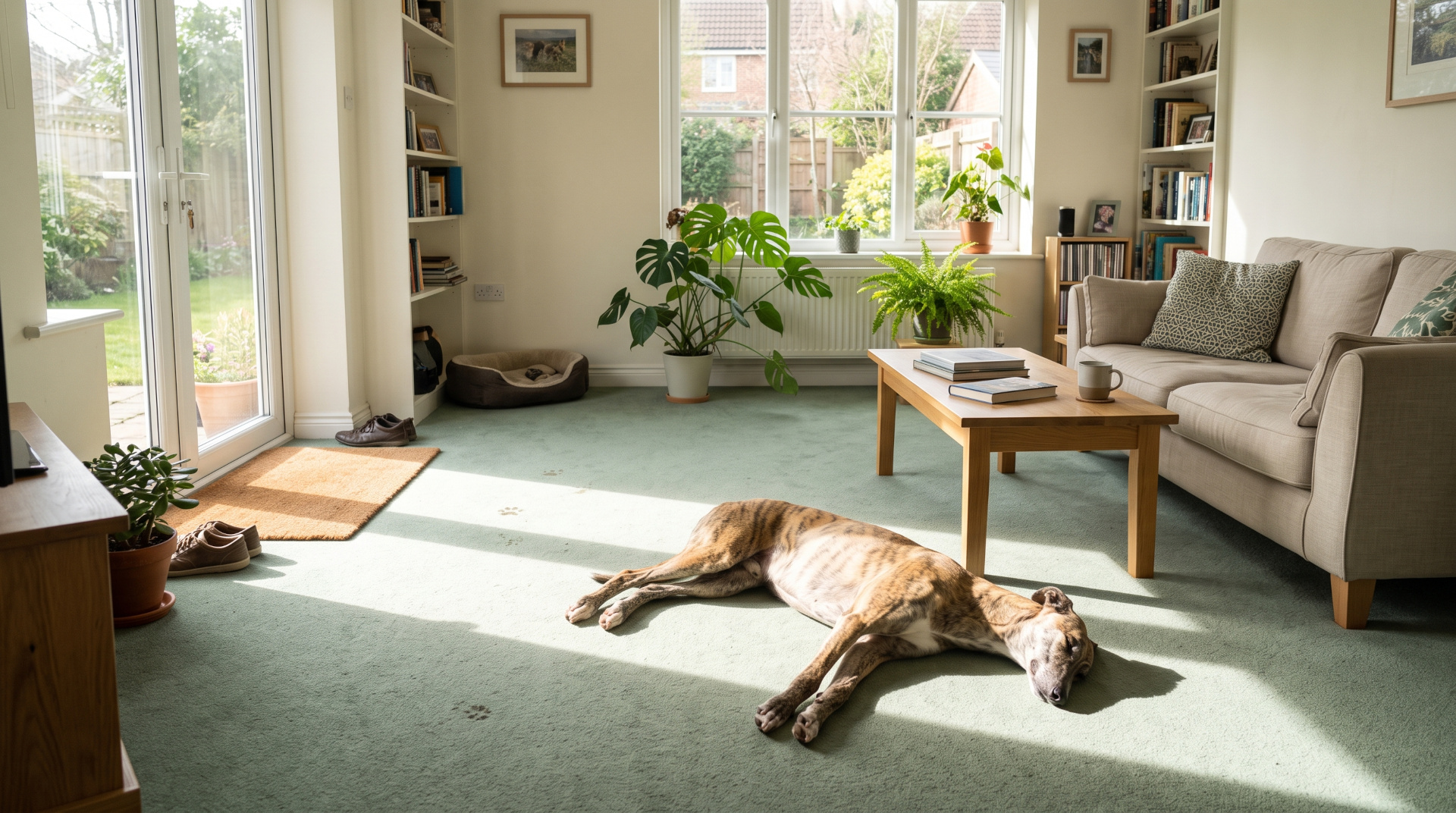
Three years ago I put a sage green carpet in our living room, which half the family thought was mad. Since then a rescue lurcher has joined us and the kids have grown into the room, yet the floor still looks better than the day it went down. Funny how that works.
The word “green” covers two entirely different products though, and mixing them up is how people end up disappointed. Colour is one meaning. The other is the eco claim, and that one covers plenty of ground. Wool, plant crops, bottles spun into yarn. Plus a fair bit of hand-waving along the way. A green carpet might be a British wool twist, or PET spun out of old bottles. (Whisper it. Sometimes it is just polypropylene in a sage shade.)
This guide unpicks both meanings. By the end you will know what makes a carpet genuinely eco, which fibres earn the label and which shades behave at home.
Jump to section:
- Why a Green Carpet Is Worth a Serious Look
- What Makes a Carpet Genuinely Eco-Friendly
- Wool, Recycled and Plant-Based Fibres for a Green Carpet
- Choosing the Right Shade of Green Carpet for Your Room
- Fitting, Underlay and Daily Care for a Green Carpet
- Allergens, Off-Gassing and Indoor Air Quality
- Where to Find a Green Carpet in Your Budget
- Frequently Asked Questions
Why a Green Carpet Is Worth a Serious Look
Green is having a moment. I understand why. Grey had its decade. Beige never really left. Green does something neither of them managed: it makes a room feel connected to the garden. It hides the odd muddy paw print as well, and in my house that counts as a design requirement.
The sustainability angle deserves more respect than it gets. Plenty of the claims you will read this year are sound. Plenty more are not. That is exactly why buyers now ask where a floor came from, who made it and what happens when it wears out. Fifteen years ago those questions earned a blank stare at most counters. Today somebody usually knows.
When nobody knows, that tells you something. “Eco” gets stretched until it snaps. A polypropylene roll from a clearance bin does not become green because a sticker says so.
My own take goes like this. Sometimes the right green carpet is a wool twist in forest green. Sometimes it is recycled PET in sage. Now and then it is a well-made synthetic in moss, because the colour matters more to you than the certificate does. No shame in that last option. I have been that customer.
What Makes a Carpet Genuinely Eco-Friendly
Five things decide how green a green carpet really is. The marketing will usually tell you about one of them. Loudly. Why only one? Because that one sells.
- Fibre origin, because everything hangs off this one. Wool grows back every year. So do sisal and coir, and jute is much the same story. Recycled PET takes bottles that were bound for the sea. Nylon gets a second spin out of factory offcuts. Virgin polypropylene is a petrochemical plant wearing nice packaging.
- Energy and water in the making. Wool scouring and spinning are thirsty work. The floor does rot down at the end of its life though.
- Treatments. Stain guard, moth proofing, fire retardancy, anti-static. Ask what yours carries. Half of these are safety. The rest are usually a sales line. (You would think after centuries of weaving cloth we would have sorted the moths. We have not.)
- Where it goes when it dies. Wool composts eventually. Synthetic carpet goes to landfill and stays put.
- Miles. Fleece that has flown round the planet carries carbon. A Yorkshire-spun alternative does not.
No certificate covers all five. Ask blunt questions and watch the pause before the reply. My opener at any counter is “where was the fibre spun?” It sorts traceable product from hopeful labels faster than any badge on a box.
Wool, Recycled and Plant-Based Fibres for a Green Carpet
“But wool is expensive.” I have stood at a counter saying exactly that with a quote in my hand, then worked the numbers over fifteen to twenty years of floor life and changed my tune.
Wool is still the strongest case going. A fresh fleece grows every spring without any help from us, and the fibre biodegrades when its life is done. Open flame does not worry it, with no chemical help required. It even ages with some dignity instead of going shiny and bald. The cost is real. A wool roll weighs a tonne and the fitter will tell you so. Spread across two decades though, the numbers stop being frightening. (Ask me how I know about the weight.)
Recycled PET is the clever trick of the last twenty years. Bottles that would have been bobbing about in the sea get spun soft and tough enough for family life. Recycled wool runs it close on ethics. That one is old jumpers and factory offcuts, bound up with a little new fibre. The trade-off fits in one line. PET is plastic when its life ends. Wool is not, recycled or otherwise.
Plant fibres are crops at heart. Sisal and seagrass. Jute and coir. All cut and regrown quickly, and they bring texture nobody can fake. They are fiddly about spills though. Bedrooms and quiet rooms for these, not kitchens. (I once watched a seagrass hallway meet a tipped dog bowl. Not recommended.)
Synthetics get dismissed too fast by the eco crowd. Modern polypropylene is cleaner to make than it was and it lasts longer, with some ranges even recyclable now. When the brief reads green, hardwearing and sensible money, a synthetic in sage answers it perfectly well.
Choosing the Right Shade of Green Carpet for Your Room
Ever brought a sample home and wondered what happened to it between the shop and your floor? The showroom lied to you, politely and with nice lamps.
Lighting decides colour more than colour does, which is annoying but true. Sage is where most people land and it is a decent landing, being greyed off enough to stay calm beside warm wood and brass. My north-facing living room flattened my favourite sage sample by the Tuesday, or the Wednesday more like, so we moved one shade warmer and I have never regretted it. Leave a sample down for a day rather than waving it about in your hand.
Forest is a different animal. It is nearly black in low light and superb as an anchor for a room, but useless at forgiving dust, as Bramble’s white hairs demonstrate on a daily basis. (The Henry hoover earns its keep in this house.) If you enjoy vacuuming, it is genuinely fine.
Olive is the one people skip and they should not. It is warmer than forest and more grounded than sage, sits happily beside leather and old furniture, and hides everyday dust better than any darker green.
Mint is a trap unless your light is good. Pale and cool, it looks lovely in a sunlit bedroom but would read like a dentist’s waiting room in my north-facing one. Know your light before that one gets ordered.
Plain or pattern is worth a moment’s thought. Plain makes the floor the loudest thing in the room. A faded damask or a soft tonal stripe lets the colour in without the floor shouting over the furniture. My vote is usually the pattern.
Grab flooring accessories for the trims while you are choosing. And ask the team which samples you can take home. (Mine live in a shoebox under the stairs. My partner has views about this.)
Fitting, Underlay and Daily Care for a Green Carpet
I fitted a hallway carpet once on the cheapest underlay I could find, and it had wrinkled inside a month. Never again. That story now gets told at the counter whenever someone reaches for the budget roll.
Natural fibres behave differently under a fitter’s knee. Wool stretches under tension and settles back afterwards. Sisal and jute do not shift at all. They usually want adhesive rather than gripper, and it is worth getting that agreed before the fitter turns up. Not on the morning of the job.
Underlay is the least glamorous purchase in flooring. It is also the one I will argue about longest. Under a natural fibre floor, PU foam or rubber protects the pile and adds years to the carpet. Our how to measure a room guide covers the quantities. Do the upgrade. Future you, on a cold morning, will say thanks.
Care is boring and it works. Vacuum twice a week where the room gets used. Blot spills instead of rubbing them, seriously. Use something meant for carpet when warm water alone will not lift it. Once a year, deep clean. Nothing exotic.
Plant fibres mark the second liquid lands on them. Keep them out of kitchens and bathrooms. Dining rooms too, frankly, unless you enjoy regret.
Furniture parked in the same spot for years will crush wool and plant piles flat. Nobody thinks about it until the marks show up. Move things twice a year. The wear evens out across the whole floor.
Allergens, Off-Gassing and Indoor Air Quality
Full disclosure: I rewrote this bit twice. With a lurcher that sheds like it is a hobby and a kid with mild asthma in the house, VOC data sheets stop being abstract.
New carpet whiffs a bit for the first few days. Off-gassing is the technical word. It comes from adhesives, backings, whatever the factory treated the fibres with. Most people never notice it. If asthma or chemical sensitivity lives in your house though, you will.
Wool is the safer bet. It barely off-gasses and it holds dust in the pile until the vacuum takes it out. The snag is that wool is an animal fibre. Natural lanolin catches a handful of people out.
Plant fibres land in between. They carry fewer treatments than most synthetics, but that textured surface holds dust, which is no gift to hay fever sufferers.
Synthetics have changed for the better. Most UK-made ranges carry low-VOC data now. Ask for the sheet. A supplier who has one finds it in seconds. A supplier who does not will change the subject.
None of this is hard. Air the place out while the fitter works and for days after. Borrow a HEPA vacuum if you do not own one. Windows open before anyone sleeps in there. Small faff, real difference. And a green carpet in a bedroom or a study is still the safest floor going for a sensitive household.
Where to Find a Green Carpet in Your Budget
No prices here, not one figure, because flooring prices move weekly and clearance stock moves daily. Anything I typed would be stale before you read it.
There are four routes in and this is the order I would use them.
- Stock ranges, to start. Flooring Factory Outlet keeps more than 120 rolls on the floor at any one time, with names turning over as the clearance changes. Merit and Essence one month, Symphony the next. Wool sits alongside the synthetics with recycled options in between, and every so often an eco fibre lands in the clearance mix. Those are gone in days, so browse affordable carpets for today’s stock and ring 020 3004 6630 before you set off.
- Remnants, if the room is small. One good end-of-roll piece covers a box bedroom for silly little money.
- A trade account, which suits landlords and multi-room refits. Trade registration takes minutes and the terms repay the form filling.
- A custom order, for when the shade has to be exactly right. Lead times are long and minimum orders apply, but you get colour and credentials together at last.
The pattern to hold on to is that green credentials cost more at the bottom of the market and stop mattering at the top. The middle is where I would spend.
Frequently Asked Questions
Is wool carpet genuinely eco-friendly?
Yes, and it is not especially close. Wool grows back every year, then rots down when its life is done. Open flame does not worry it either, with no chemical help required. Imported fleece does carry air miles though, and some wool gets treated with something. Ask where the fleece was spun and what the carpet gets treated with. A decent supplier answers in seconds.
How do recycled fibre carpets compare with wool?
Close enough that most families would never tell the difference. Softness and stain handling are near as makes no difference and the price is kinder. The bottles also stay out of the sea, which is rather the point. Wool still wins on longevity, as it usually does.
Is a green carpet a problem for allergies?
Normally not. Wool and plant fibres rarely cause trouble. A few people react to the natural lanolin in wool, which tends to surprise them. Watch the synthetics in a sensitive house. It is the treatments that bother people. Get the VOC data and ventilate hard after fitting.
Can I lay a natural fibre carpet myself?
In a simple square room with synthetic or PET, have a go. Sisal and jute need adhesive and patience, plus a strong back. Wool forgives mistakes but weighs a tonne. Trust me on that. Stairs and seam joins are worth paying a fitter for.
How long does a green carpet last?
Wool gives you fifteen to twenty years with decent care. Good recycled PET and synthetics manage seven to fifteen. Plant fibres get about ten in quiet rooms. Hallways shorten every one of those figures.
Will the green colour fade?
Eventually. Sunlight wins in the end. Wool holds colour best and plant fibres drift in tone, sometimes noticeably. Blinds in south-facing rooms help. So does moving the furniture twice a year.
Where can I see green carpet options before I commit?
The carpet range at Flooring Factory Outlet, 66 Purley Way, Croydon, CR0 3JP, keeps more than 120 rolls on a normal week. Greens and naturals appear when the clearance allows. Ring 020 3004 6630 first, because what is on the floor changes week to week.
Funny how it works out. The sample you nearly walked past on the rack is often the one that ends up on your floor (ask me about the sage sometime), so bring your measurements to the showroom at 66 Purley Way, Croydon, CR0 3JP and let the team settle everything from the shade to the trims in a single visit. Free parking next to Matalan and The Range, and tea while you decide, obviously. Stuck before then? The flooring FAQ helps. You can also ring 020 3004 6630 and ask for whoever is on the flooring desk. They are a decent bunch.